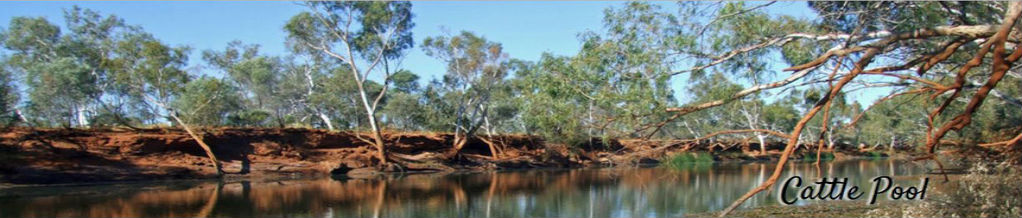
The Degrey-Mullewa stock route was gazetted around June 1893 and is approx 1400 km long. Charles Straker arrived via the Surat on the 25.1.1882. He started out as a jackeroo at Millstream. He then became a station overseer at Croydon, Roebourne and George River stations.
Leased Tambrey Station but was forced off due to drought. In partnership with Duncan McRae bought Croydon Station in 1899. Also had interests in Coolawamyah and Hammersley Stations. He also was a JP and served on the Tableland Road Board. Charles passed away at Hammersley Station during June 1920 aged 63.
In July 1895 Mr Charles Mitchinson Straker started out from Mullewa to locate and dig the stock wells. By the beginning of August 1895 he had dug wells 1, 2 and 3. These wells were serviced by a pair of 52ft troughs. In November 1899 he had reached the Robe River Pool where Well 45 is located.
The stock route over the course of time was re surveyed in places. As a drover commented in 1928 that they always travelled the most direct route between wells. Following the twists of a river added many miles more to the trek.
From our correspondent Adelaide 1893
The following are the particulars of the stock route from De Grey River, southwards, gazetted yesterday :-
A strip of land, starting from the De Grey River, and extending in a west-south westerly direction to Roebourne, via
Moorambine Pool
Mackay's Homestead at Mundubullangana Pool
Peeawah Trigonometrical Station
Coorinjinna Pool
Terens Pool
Boona Booka Jacka Pool
thence in a westerly direction to the Fortescue Telegraph station via
Cowaranda Pool
Gimriki Pool on the Yannarie River
Erramurra Pool
thence in a general southerly direction to Chalyarn Spring in the Robe River, via Mardie Pool and Woolhouse's Homestead in North Location 57
thence passing near Red Hill to Reserve 1108, at Duck Creek, and along the right bank of said Creek to its junction with the Ashburton River, and along the right bank of the said river to Reserve 1235
thence crossing said Ashburton River and along the right bank of the Henry River upward to tne crossing near survey mark A/108
thence to the Blue Rock Pool and southward to the crossing at the junction of the Alma River with the Lyons River, and along left bank of said Lyons River downwards to Binthanbooka Pool ;
thence crossing Davis's Creek, Arthur River, Wyndham River, and the Gascoyne near its junction with the Dairie Creek, and along the left bank of said Dairie Creek to survey mark V47, and thence to Bilung Pool
thence crossing the Wooramel River at Pandara
thence crossing Yarra-Yarra Creek near Mearearbundie
and thence in a south-south-easterly direction passing near Charlie Well and crossing the Murchison River at Elizabeth Springs and downwards along its left bank crossing the Roderick and Sanford Rivers and Coolarburloo Brook near its junction with the said Murchison River
thence southward to tbe Greenough River at Coolinga Spring and along its right bank downwards crossing it near Indindie Springs: thence south-south west to Wooderarrung, via "The Rocks" and Bedan Well
thence via Mullewa to the (northernmost boundary of Reserve 2138 Stock Route).
The Northern Stock Route August 1895
We have received from the Under-Secretary of the Public Works Department the following abstracted report by Mr. C. M. Straker, on the Northern stock route , North Spring August 5th, 1895.I have the honour to report for the information of the Minister as to work done and general state of affairs on Northern stock route. Since forwarding my July report I am happy to inform you that the three first walls have been completed, and camp has been shifted from Woodradden to this spot, which is a distance of about 40 miles from Mullewa.
The three wells completed have each an ample supply of water, of which you have been previously advised. No. 1 well is fenced in with a jam stake picket fence. No. 2 and 3 are fenced securely with stout posts and rails of salmon guts.
At each well a set of 52ft. of strong galvanised iron troughs are laid. These are fenced in with a three rail strong gum fence, so placed as to allow either cattle, horses, or sheep to drink with ease, but to prevent any stock getting into or over the troughs. At each welli a strong windlass has been put up, and two seven gallon galvanised iron buckets, fixed with lipht galvanised iron chains.
The whole of the work is strong and substantial, and with fair treatment, these wells should remain serviceable for years without further expense.
News From Geraldton October 1895
Mr. Striker is engaged in opening a stock route between Mullewa and the DeGrey. He is now in town and reports having bored down wells for 160 miles from Mullewa at a distance of twelve miles apart. The work is likely to last many months longer. Each well is guaranteed to water 3,000 sheep or 300 head of cattle. He has found the hand boring machine of great service in the discovery of water.Legislative Assembly October 1895
Mr. HARPER, by leave of the House, asked without notice whether the Government were aware that it was reported that the mode of sinking wells on the Stock Route in the Murchison district was ill-judged and unsatisfactory. The report reaching him was that wells were being sunk only a few yards — in one case 150 yards — from existing wells on stations, and of course there could be little or no need left in such localities for travelling stock as the station sheep had to be watered there also.Another complaint was that the stages between wells were too long. A third complaint was that, instead of the wells being sunk, where water could be obtained at a com paratively shallow depth, so as not to be too laborious for drovers who had to draw water for large numbers of travelling stock, the wells were sunk in places where the water was at so great a depth that the labor of drawing water for stock must be excessive, if not impracticable.
If these complaints were true, the wells along this Stock Route would not reasonably serve the purpose for which they, were intended.
The PREMIER (Hon. Sir J. Forrest) said he was inclined to think the hon. member could not have been correctly informed. He had seen one or two reports sent from (the district, showing the progress of the work. The last report showed that a number of wells had been sunk at distances of 15 to 20 miles apart, and these wells were not near a station. The well-sinking had commenced at Mullewa, going northward to the Greenough River, then by, the Worth Spring to Tallering, and crossing over to Ballinyoo.
The reports received were very satisfactory, and the statements of drovers were to the effect that the Government were now doing the right thing along this Stock Route, and finishing off the wells by equipping them with good buckets and troughs and everything that was necessary.
He had not received any reports during the last month, but would make inquiry into the statement as to unsatisfactory work.He was satisfied, at present, that the hon. member was misinformed, because the Government had a practical man in charge of the party, Mr. Straker a North-West squatter, who under stood what was wanted, and was not likely to put wells in places where they would not be serviceable.
As to the wells being deeper than was necessary, that was a question of going down till the water was reached. He supposed 20 feet depth, or so, would be the average.
MR LOTON said he had that day seen a drover who had just come over that road with stock, and his statement was that the work in connection with the wells was admirably done by far as it had gone, but that in several instances the wells were sunk in the wrong places.
The depth being 24 to 40 feet, while within a short distance water could have been obtained in abundance at 10 to 12 feet. If that was the case, the greater depth would make the drawing very difficult, and would compel the drovers to draw the water an extra 20 feet or more without necessity.
The COMMISSIONER OF CROWN LANDS (Hon. A. R. Richardson,) said he had had, indirectly, a good deal to do with the question of the Stock Route, the work having been placed in the charge of the Attorney General and himself, who continued it up to a certain point and then handed it over to the Works Department.
He had been instrumental in securing the services of Mr. Straker, who was a good practical man to have in charge of the work. One point he had particularly im pressed on Mr. Straker was the necessity of getting as far as possible from the ordinary Stock Route and the sheep station paddocks, so that the travelling stock might have a chance of getting some feed as well as water, away from the ordinary route of the stations.
There would be no feed near a station well. He thought Mr. Straker would, as he had advised him, keep the line of Government wells as far as possible from the stations therefore he could not understand how Mr. Straker could have been making such a mistake as had been reported.
Perhaps Mr. Straker might be able, when called upon, to explain the matter clearly. He (the Commissioner) had already mentioned the report to the Director of Public Works, and asked him not to rest, until satisfied that either the information was wrong, or that the work was being done properly.
He (the Commissioner) had also been told by many persons who had travelled over this Stock Route that Mr. Straker was doing really good work, and making a splendidly finished job of the wells.
Mr. RANDELL said he had recently taken the opportunity of speaking to a drover who had passed over that Stock Route, and the drover spoke of the admirable way in which the wells were sunk and equipped with appliances. From what this drover said, they appeared to be thoroughly serviceable wells, and no complaint on any score was mentioned.
MR A.FORREST said he agreed with what had fallen from the hon. member for the Swan (Mr. Loton). One of the most experienced drovers on the North-West coast informed him that the officer in charge had made the wells so deep that it was almost impracticable for drovers to water a large number of travelling stock also that there were many places where water could be got at a depth of 10 to 20ft whereas the Government wells were down 40ft.
In some places. When there was only one man available for watering a mob, and he had to draw water 40ft, the work of watering would be almost impossible. The same drover had told him only that morning, that if more care were taken in picking spots for wells, there would be no occasion to make them so deep. With this exception, the officer in charge was doing the work satisfactorily. It was well known that in all the Murchison district water could be obtained by sinking 10 to 20ft and he believed 20ft depth was the limit in the district, at the stations; Wells 40ft deep must be almost useless for watering travelling stock. The subject dropped.
Northern Stock Route. Report Prom The Officer In Charge. December 1895
The Under-secretary for Works has lately received two reports from Mr. Charles M Straker, officer in charge of the Northern stock route (Murchison River). In the first Mr. Straker replies to criticisms regarding certain working connection with the extension of the route, and in the second particulars relating to progress in sinking wells etc are given.The first statement Ís dated November 2nd, Mr. Straker refers to a report made during September, in which it was mentioned that well No. 6 and 7 were much too close to existing wells, owing to the fact that it was not possible to obtain water any distance away. Two "duffer" holes had been put down, but had to be abandoned because water was not found at a fair depth. The first statement Ís dated November 2nd, Mr. Straker refers to a report made during September, in which it was mentioned that well No. 6 and 7 were much too close to existing wells, owing to the fact that it was not possible to obtain water any distance away. Two "duffer" holes had been put down, but had to be abandoned because water was not found at a fair depth.
In selecting sites for these wells it was seen that the most suitable places were close to existing wells, but knowing the disadvantages a consequent on this, he had determined to try further away. The result, however was unsatisfactory, and he was compelled to come back and sink close to settlers wells. At No. 8 well two men had been boring for over a week, putting down 12 holes and getting in each case salt water. The thirteenth hole was put down within a mile of one of the Billabong station wells fresh water being obtained.
In reply to the charge that the wells are too small, Mr. Straker states that the sizes are in one case 7ft. by 5ft. in the clear, in another 6ft. by 6ft, and the remainder 6ft. - 6ft. round. Every effort was being used to make the wells available for years and to leave them in gocd condition. Difficulty had been experienced in finding sufficient timber for covering them, and it would in many cases have been impossible to have procured the greater lengths requisite had the wells been of larger dimensions.
Mr. Straker believes that it is not advisable to make storage chambers at the bottom of wells unless the supply should be derived merely from a soak. He points out that in time the water generally sinks to a lower level, and many wells which have bad drives or chambers put in have become useless through the water level falling so low that even the floors are above it.
To sink on the water means a few feet extra haulage for those using the well, but as it produces a permanent instead of a temporary well the work is, in his opinion, amply justified. Mr. Straker, in conclusion, states that all the drovers who have had opportunities of judging, with the exception of one, have expressed themselves as highly satisfied with the work done and the facilities given for watering stock
Mr. Strakers second report is dated November 6th. The writer mentions that in his last monthly report, dated October 9th, he informed tho Minister that some men were boring to find a suitable spot for No. 9 well, while others were on the way up the route to start work at No. 10. The report continues :
After putting down three bore holes, the first two of which proved, salt, we obtained very fair water in a suitable position for No 9 well. We at once started to sink, and at 24ft. had got a sufficient supply of water which, though rather brackish, is excellent for stock, indeed, it was good enough for the men to. drink while at work. The well was completed on the 5th inst.
At No. 10 fresh water was obtained from the first bore put down. The well is now 20ft. deep. Water of first class quality was struck at 13ft., and it was hoped that at about 2 ft. an ample supply would be obtained as the supply was increasing in volume at depth. A start was being made up the river with the men who had just finished No. 9 well to start boring for No. 11 well.
Difficulty was anticipated in getting, fresh water, but with the aid of the borer it was hoped to succeed. I am happy to inform you the writer continues that since my last report several of the wells i have had a very fair test, as they have been used by travelling sheep, and I am glad to to say all proved perfectly satisfactory, both for the supply of water and the appliances with which to draw it.
At the No 3 well, which is the deepest so far, being 43ft, two flocks of sheep, totaling over 4,000, and 50 head of cart horses, were watered on the same day. The last flock ot sheep had been without water for three days, and consequently drank nearly double the quantity ordinarily consumed. Those in charge of the sheep expressed great satisfaction with the position of the wells and the manner in which the work was done.
These facts, Mr. Straker maintains, indicate that the work had not been done in the unsatisfactory manner alleged in certain quarters.In selecting sites for these wells it was seen that the most suitable places were close to existing wells, but knowing the disadvantages a consequent on this, he had determined to try further away. The result, however was unsatisfactory, and he was compelled to come back and sink close to settlers wells.
General News Febuary 1896
Mr C. M Straker is doing good work in sinking wells on the northern stock route from the Murchison river. The tenth well is now being completed, the eleventh will bo completed very shortly and in the twelfth well, after several futile efforts good water has been struck. At the date of his last report Mr Straker was boring for water at the thirteenth well.Local And General May 1896
The well sinking party under Mr. C. M. Straker engaged in providing a water supply at convenient stages along the Mullewa Roebourne section of the northern stock route are making satisfactory progress northwards, says the Nor-West Public Opinion.They were at No. 17 well close to Nairn Bros station on March 12 and hope to be on the Gascoyne River very shortly. Considerable impediment was caused about the Murchison district through salt water getting into the bore holes, but after some trouble the difficulty was overcome. The uncertain nature of the sinking precludes an approximate computation of the time the work will occupy before it is completed.
The Ministry's Misdoings. To The Editor January 1897
For instance, how many more years is Mr Chas Straker going to be on the stock route? If the present Government have any sympathy with the North and are anxious to supply the Southern people with cheaper meat why do they not double Mr Straker's party? It must be monotonous supervising three wells under construction. There is no reason whatever why he could not have had six wells continually under way all this time. How is it a party did not start from the Roebourne end and also a party from the Oakover?Roebourne Roads Board October 1897
Memo from Messrs Mackay Brothers pointing out that the Peeawah Well was in such a bad state as to be useless to travellers and suggesting that it has caved in since being deepened. It should be cleaned out and a box put in. The stage between the two other nearest wells was 25 miles. The secretary was instructed to reply that particulars and estimate of cost be sent in and the matter would then be represented to Mr. C. M. Straker, supervisor of the northern stock route water supply.Western Australian Stock Routes November 1899
Mullew to Roebourne.About 700 miles. This route runs in a generally northerly direction from Mullewa till it reaches the neighbourhood of the Bobe Biver, on the North-West Coast. It then bends north-easterly and follows the general line of the coast to Roebourne.
The supervisor Mr. Straker, commenced operations some three years ago at Mullewa, and has now advanced to a little above the Robe River. He has adopted one or two slight deviations from the gazetted course, or the course shown on the lithographs as after inspection he found that more favourable country as regards feed and water were to be obtained.
I am considering this section as running through on its main line to the southward of Mount Gregory to Boona Boona, Jacka Pool, on the Jones River, and as a diversion into Roebourne, which I believe will be required for the shipping of stock and also for the Boehourne and Cossack food supplies.
Kimberley and North-West stock travelling to Perth would not need to pass through Roebourne and it is not desirable that they should do so. Mr Straker has all along been working with the object of providing for 3000 head of sheep, and he reports his belief that any well on his line is capable of watering 4000 head of sheep.
Mr. Straker's personal knowledge of the stock industry should form the best guarantee at present available that nothing but ordinary maintenance work should be necessary. Unfortunately, however different authorities hold somewhat varying views on this point and if Mr. Straker's estimates in this direction are erroneous it may add as much as £5000 to the estimates to make good the deficiency.
Roebourne to the Degrey River.
About 260 miles. This section starting from Roebourne pursues the course of the Roebourne deviation to Boona Boona, Jacka Fool, on the Jones River. It then follows the stock route line as shown on the plans as far as Mackay's station at Muudubullangana.
From this point it would appear to be of advantage to keep to the north-ward along the track which is apparently in common use and along the course of which some more or less efficient watering places have already been constructed.
This course follows more nearly the coast line and rejoins the stock route reserve line at the De Grey River. No inspection of the line, from a stock route point of view has yet been made and consequently there is but little if any information as to its character in this office and what little there is is not of much use for present purposes.
It is of course impossible to figure out the present carrying capacity. Still from my own personal knowledge I can say that at times there is a good deal of stock traffic on the road. The works required comprise the construction of two new wells, and the improvement and enlarging of storage capacity of nine existing wells, together with provision of the usual fittings.
Northern Public Opinion and Mining and Pastoral News 1898
The well sinking being conducted Mr Straker has been halted by the state government indefinitely. Mr Straker and his well sinking parties will be renumerated in a few weeks.Wells 51 and 52 near Karratha have been started and will be the final wells. There is still 180 miles of stock route that will use existing wells or springs.